
Choosing a health insurance plan—or processing claims for one—often feels like trying to translate a foreign language. With acronyms like PPO, HMO, EPO, and POS thrown around, it’s easy to get lost in the alphabet soup.
However, understanding the differences between these plans isn't just important for patients trying to save money; it is absolutely critical for healthcare providers, medical billers, and coders to prevent claim denials.
Here is a comprehensive breakdown of the four main types of health insurance plans, what sets them apart, and why getting them right is the key to seamless medical billing.
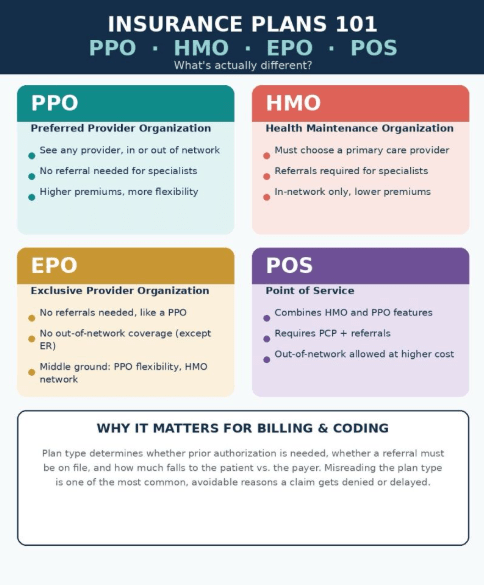
The Big Four: PPO, HMO, EPO, and POS Explained
Each type of health insurance plan balances two main factors: cost (premiums and out-of-pocket expenses) and flexibility (which doctors you can see and whether you need referrals).
1. PPO (Preferred Provider Organization)
- The Pitch: Maximum flexibility and freedom of choice.
- How it works: PPO plans allow you to see any healthcare provider you want, whether they are in-network or out-of-network, without needing a referral. You do not need to select a Primary Care Physician (PCP).
- The Catch: This ultimate flexibility comes at a price. PPOs typically have the highest monthly premiums and higher out-of-pocket costs.
2. HMO (Health Maintenance Organization)
- The Pitch: Budget-friendly care with strict boundaries.
- How it works: HMOs require you to choose a Primary Care Physician (PCP) who acts as the "gatekeeper" of your care. To see a specialist (like a dermatologist or cardiologist), you must first get a referral from your PCP. Except for true emergencies, HMOs will not cover any out-of-network care.
- The Catch: Low flexibility. If you see an out-of-network doctor or skip the referral process, you will likely have to pay 100% of the bill yourself. However, HMOs offer some of the lowest premiums and deductibles.
3. EPO (Exclusive Provider Organization)
- The Pitch: The middle ground between PPO flexibility and HMO rates.
- How it works: Like a PPO, you don't need referrals to see specialists, and you aren't forced to designate a PCP. However, like an HMO, you are strictly limited to an in-network list of doctors. Out-of-network care is not covered at all (except for emergency room visits).
- The Catch: You get the freedom of bypassing the referral process, but you must remain highly vigilant about ensuring every provider you see is strictly in-network.
4. POS (Point of Service)
- The Pitch: A hybrid plan that blends HMO rules with PPO out-of-network freedom.
- How it works: POS plans require you to select a PCP and obtain referrals for specialists, just like an HMO. However, unlike an HMO, you are allowed to go out-of-network for care if you are willing to pay a higher share of the cost.
- The Catch: It requires the administrative tracking of an HMO (PCP gatekeeper + referrals) but charges higher out-of-pocket costs if you choose to step outside the network.
Comparison Table: PPO vs. HMO vs. EPO vs. POS
| Plan Type | PCP Required? | Referrals Needed for Specialists? | Out-of-Network Coverage? | Cost Level (Premiums) |
| PPO | No | No | Yes | High |
| HMO | Yes | Yes | No (except emergencies) | Low |
| EPO | No | No | No (except emergencies) | Moderate |
| POS | Yes | Yes | Yes (at higher cost) | Moderate |
Why This Matters for Medical Billing and Coding
For medical billing and coding professionals, these plan differences are much more than just a consumer choice—they are the boundary lines between a paid claim and a costly denial.
The type of plan a patient holds dictates the administrative rules a billing department must follow:
1. Prior Authorization Hurdles
Plan types dictate whether prior authorization is needed before a procedure can take place. Attempting to bill for a high-tech imaging scan or surgery without securing prior authorization for an HMO or EPO patient will result in an immediate, hard denial from the payer.
2. The Referral Paper Trail
For HMO and POS plans, referrals must be on file before a specialist provides care. If a specialist's office submits a claim for a consultation without the corresponding referral ID from the patient’s PCP, the insurance company will reject the claim. The provider’s office is then left trying to retroactively secure paperwork or write off the loss.
3. Patient vs. Payer Responsibility
Understanding the plan type is key to calculating how much of the bill falls to the patient versus the payer. For instance:
- If an EPO patient accidentally receives non-emergency care from an out-of-network provider, the patient is responsible for 100% of the bill.
- Under a POS or PPO, the payer will cover a portion of the out-of-network care, but the biller must accurately apply the higher out-of-network coinsurance rate to the patient's statement.
The Golden Rule of Medical Billing:
Misreading or failing to verify the patient's insurance plan type is one of the most common, yet entirely avoidable, reasons a medical claim gets delayed or denied.
Best Practices for Healthcare Providers
To keep your clean claim rate high and avoid revenue leaks, implement these front-desk and billing habits:
- Verify eligibility early: Never skip real-time eligibility (RTE) checks before the patient’s appointment. Confirm the plan type active on that exact date.
- Flag referral-heavy plans: Build alerts into your Electronic Health Record (EHR) system for HMO and POS patients to remind staff to request and upload PCP referrals before the visit.
- Educate the patient: If a patient with an EPO or HMO is seeking care that requires out-of-network providers (such as external lab work), warn them beforehand to protect them from unexpected medical debt.
