
Medical billing is one of the most important parts of a healthcare practice's revenue cycle. Even a small mistake in a claim can prevent it from being accepted by the insurance company. One of the most common issues healthcare providers face is claim rejection.
Understanding why claims are rejected can help your practice reduce delays, improve cash flow, and increase first-pass claim acceptance rates.
What Is a Claim Rejection in Medical Billing?
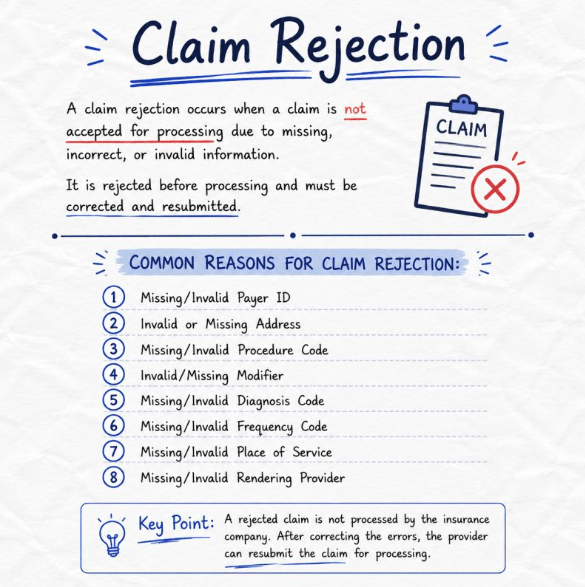
A claim rejection occurs when a medical claim is not accepted by the insurance company or clearinghouse for processing because it contains missing, incorrect, or invalid information.
Unlike a claim denial, a rejected claim has not entered the payer's adjudication process. It must first be corrected and then resubmitted before the insurance company can review it.
Claim Rejection vs. Claim Denial
| Claim Rejection | Claim Denial |
|---|---|
| Claim is not accepted for processing. | Claim is processed but payment is denied. |
| Usually caused by missing or incorrect information. | Usually caused by coverage or medical necessity issues. |
| Can often be corrected and resubmitted quickly. | May require an appeal, additional documentation, or correction. |
Common Reasons for Claim Rejection
Below are the most common reasons medical claims are rejected.
1. Missing or Invalid Payer ID
Every insurance company has a unique payer ID. Entering the wrong payer ID sends the claim to the wrong destination or prevents it from being processed.
How to prevent it:
- Verify payer IDs before claim submission.
- Keep payer information updated in your billing software.
2. Invalid or Missing Patient Address
Incorrect or incomplete patient demographic information is a frequent cause of claim rejection.
Examples include:
- Missing ZIP code
- Incorrect street address
- Invalid city or state
Best Practice:
Verify patient demographics during every visit.
3. Missing or Invalid Procedure Code
Procedure codes (CPT® or HCPCS codes) describe the services provided.
Claims may be rejected if:
- The code is missing
- The code is inactive
- The code is entered incorrectly
Tip:
Always use the most current CPT and HCPCS code sets.
4. Invalid or Missing Modifier
Modifiers provide additional information about a procedure.
Using the wrong modifier—or forgetting to include one when required—can result in claim rejection.
Examples include:
- Modifier 25
- Modifier 59
- Modifier 95 for telehealth (when applicable)
Always verify payer-specific modifier requirements.
5. Missing or Invalid Diagnosis Code
Diagnosis codes (ICD-10-CM) explain why a service was medically necessary.
Claims may be rejected if:
- The diagnosis code is invalid
- The diagnosis code has expired
- The diagnosis does not match the procedure
Regular coding updates help reduce these errors.
6. Missing or Invalid Frequency Code
Frequency codes indicate whether a claim is:
- Original
- Replacement
- Corrected
- Void
Using the wrong frequency code may prevent the claim from being accepted.
7. Missing or Invalid Place of Service (POS)
The Place of Service code tells the payer where the patient received care.
Common POS codes include:
- POS 11 – Office
- POS 22 – Outpatient Hospital
- POS 02 – Telehealth
An incorrect POS code can trigger an immediate rejection.
8. Missing or Invalid Rendering Provider
Every claim must identify the provider who performed the service.
Common issues include:
- Missing NPI
- Invalid NPI
- Provider not credentialed with the payer
- Incorrect provider information
Always verify provider enrollment and credentialing before billing.
How to Reduce Claim Rejections
Healthcare practices can significantly reduce claim rejections by following a few simple best practices:
- Verify patient eligibility before every visit.
- Confirm patient demographic information.
- Keep provider credentialing up to date.
- Use current CPT, HCPCS, and ICD-10 code sets.
- Validate claims before submission.
- Monitor rejection reports regularly.
- Train billing staff on payer-specific requirements.
These proactive steps can improve your first-pass claim acceptance rate and reduce delays in reimbursement.
Why Reducing Claim Rejections Matters
Claim rejections may seem like minor administrative issues, but they can have a major impact on your practice's financial health.
Reducing claim rejections helps:
- Improve cash flow
- Accelerate reimbursements
- Reduce administrative workload
- Increase billing efficiency
- Improve overall revenue cycle performance
Even a small reduction in claim rejections can lead to faster payments and fewer billing headaches.
How PayDoc Medical Solutions Can Help
At PayDoc Medical Solutions, we specialize in helping healthcare providers optimize their Revenue Cycle Management (RCM) by reducing claim errors and maximizing reimbursement.
Our experienced billing team provides:
- Medical Billing Services
- Claim Scrubbing and Submission
- Denial & Rejection Management
- Payment Posting
- Accounts Receivable (AR) Follow-Up
- Eligibility Verification
- Provider Credentialing
- Revenue Cycle Management (RCM)
Our goal is to help your practice improve claim accuracy, reduce rejections, and receive payments faster.
Need Help Reducing Claim Rejections?
If your practice is experiencing frequent claim rejections or delayed reimbursements, our team is here to help.
Contact PayDoc Medical Solutions today to learn how our medical billing experts can improve your billing workflow, increase your first-pass acceptance rate, and maximize your practice's revenue.
