
Medical claim denials continue to be one of the biggest reasons healthcare providers lose revenue. While many denied claims can eventually be appealed, the process consumes valuable staff time, delays reimbursements, and increases administrative costs.
The good news is that most claim denials are preventable. By following a standardized Clean Claim Checklist, healthcare providers and medical billing teams can significantly improve first-pass claim acceptance rates, reduce rework, and maintain a healthy revenue cycle.
In this guide, we'll explain what a clean claim is, why it matters, and the essential steps every practice should follow before submitting claims to insurance companies.
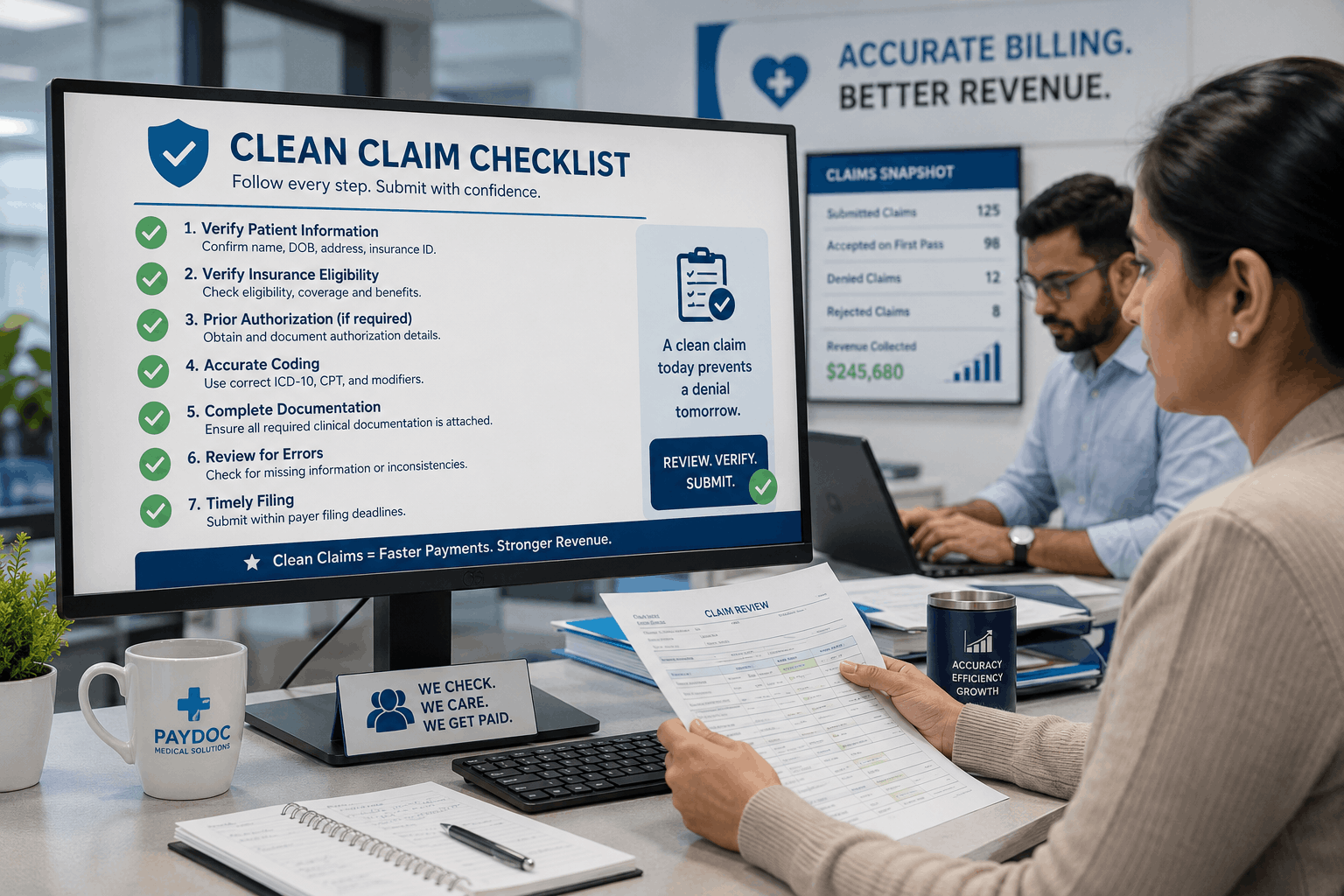
What Is a Clean Claim?
A clean claim is a medical claim that is submitted correctly the first time without missing information, coding errors, eligibility issues, or documentation deficiencies. Because the claim meets payer requirements, it can be processed and paid without additional requests or corrections.
Submitting clean claims helps practices:
- Increase first-pass acceptance rates
- Reduce claim denials
- Receive faster reimbursements
- Improve cash flow
- Lower administrative costs
- Increase overall practice profitability
Why Clean Claims Matter
Every rejected or denied claim requires additional work from your billing staff. This means:
- Lost productivity
- Delayed payments
- Increased Accounts Receivable (A/R)
- Higher operational costs
- Frustrated providers and patients
Even small mistakes—such as a missing modifier, incorrect insurance ID, or outdated patient information—can delay payment for weeks.
A structured checklist minimizes these risks.
The Ultimate Clean Claim Checklist
1. Verify Patient Demographics
Before every visit, confirm:
- Full legal name
- Date of birth
- Address
- Phone number
- Gender
- Insurance ID
- Subscriber information
Even minor spelling mistakes can result in claim rejection.
2. Confirm Insurance Eligibility
Always verify:
- Active insurance coverage
- Effective dates
- Copay
- Deductible
- Coinsurance
- Benefit limitations
- Referral requirements
Eligibility verification prevents avoidable denials before services are performed.
3. Obtain Prior Authorization (If Required)
Many procedures require prior authorization.
Always verify:
- Authorization approval
- Authorization number
- Approved CPT codes
- Approved diagnosis
- Service dates
- Number of approved visits
Failure to obtain authorization is one of the most common reasons for claim denials.
4. Review Medical Documentation
Documentation should support every billed service.
Ensure documentation includes:
- Provider notes
- Medical necessity
- Diagnoses
- Procedures performed
- Orders
- Test results (when applicable)
Incomplete documentation often leads to denials during payer review.
5. Assign Accurate Diagnosis Codes (ICD-10-CM)
Confirm that diagnosis codes are:
- Current
- Specific
- Supported by documentation
- Ordered correctly
Avoid unspecified diagnosis codes whenever possible.
6. Use Correct CPT and HCPCS Codes
Double-check:
- Procedure codes
- Time-based services
- Units billed
- HCPCS Level II codes
- Bundled services
- Unbundling errors
Coding accuracy directly impacts reimbursement.
7. Apply Appropriate Modifiers
Incorrect or missing modifiers can cause immediate rejection.
Common modifier issues include:
- Missing modifier
- Incorrect modifier
- Incompatible modifier combinations
Review payer-specific modifier guidelines before submission.
8. Verify Provider Information
Confirm:
- NPI number
- Tax ID
- Billing provider
- Rendering provider
- Referring provider (when required)
- Credentialing status
Provider information must match payer records.
9. Check Claim Form Accuracy
Whether submitting CMS-1500 or UB-04 claims, verify:
- Patient information
- Insurance information
- Dates of service
- Place of service
- Diagnosis pointers
- Charges
- Units
- Provider information
A simple typo can delay payment.
10. Ensure Timely Filing
Every insurance company has filing deadlines.
Submit claims within payer limits to avoid automatic denials.
11. Run Claim Scrubbing
Use billing software or clearinghouse claim scrubbing tools to identify:
- Missing fields
- Coding conflicts
- Duplicate claims
- Invalid diagnosis combinations
- Invalid modifiers
- Formatting errors
Claim scrubbing catches errors before submission.
12. Final Quality Review Before Submission
Perform one final review:
✔ Patient verified
✔ Insurance verified
✔ Authorization obtained
✔ Documentation complete
✔ ICD-10 accurate
✔ CPT accurate
✔ Modifiers correct
✔ Provider information verified
✔ Charges reviewed
✔ Timely filing confirmed
✔ Claim scrubbed
✔ Ready for submission
Common Reasons Claims Are Rejected
Practices frequently experience claim rejections because of:
- Invalid patient information
- Inactive insurance
- Missing prior authorization
- Incorrect coding
- Missing modifiers
- Duplicate claims
- Missing documentation
- Incorrect provider details
- Timely filing violations
Most of these issues can be avoided by following a standardized checklist.
Best Practices for Maintaining High Clean Claim Rates
To consistently improve claim quality:
- Train billing staff regularly
- Conduct internal coding audits
- Verify insurance before every visit
- Maintain accurate patient records
- Monitor denial trends monthly
- Use automated claim scrubbing tools
- Keep coding resources updated
- Review payer policy changes regularly
How PayDoc Medical Solutions Helps
At PayDoc Medical Solutions, we help healthcare providers maximize reimbursements through accurate medical billing and proactive revenue cycle management.
Our services include:
- Insurance Eligibility Verification
- Prior Authorization
- Medical Coding
- Claim Submission
- Claim Scrubbing
- Denial Management
- Payment Posting
- Accounts Receivable Follow-Up
- Credentialing
- Revenue Cycle Management (RCM)
By implementing proven billing workflows and quality control processes, we help practices reduce denials, improve first-pass acceptance rates, and get paid faster.
Frequently Asked Questions
What is a clean claim?
A clean claim is a claim submitted without errors, missing information, or coding issues, allowing the payer to process it without delays.
Why are clean claims important?
Clean claims reduce denials, speed up reimbursements, improve cash flow, and lower administrative costs.
How can I reduce claim denials?
Verify patient eligibility, obtain required authorizations, use accurate coding, review documentation, and perform claim scrubbing before submission.
What is claim scrubbing?
Claim scrubbing is an automated or manual review process that identifies billing errors before claims are sent to insurance companies.
What is the biggest cause of claim denials?
Common causes include missing prior authorization, incorrect coding, inactive insurance, incomplete documentation, and billing errors.
