
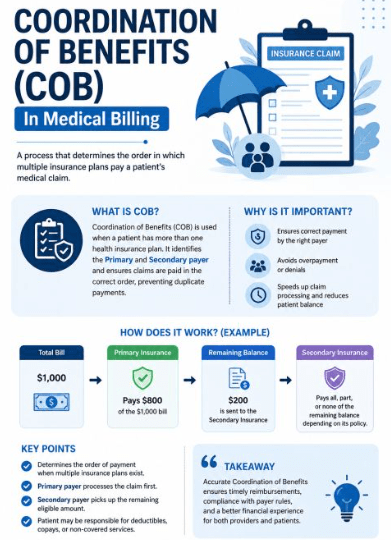
Accurate insurance billing is one of the most important aspects of a successful healthcare practice. When a patient has more than one active health insurance policy, determining which insurance company should pay first is critical. This process is known as Coordination of Benefits (COB).
Understanding Coordination of Benefits in Medical Billing helps healthcare providers reduce claim errors, avoid payment delays, and maximize reimbursements.
What Is Coordination of Benefits (COB)?
Coordination of Benefits (COB) is the process used by insurance companies to determine the order in which multiple health insurance plans pay for a patient's medical expenses.
When a patient has two or more insurance plans, one insurance company becomes the Primary Payer, while the other becomes the Secondary Payer (and in some cases, a tertiary payer may also be involved).
The purpose of COB is to:
- Prevent duplicate payments.
- Ensure healthcare providers receive the correct reimbursement.
- Determine the financial responsibility of each insurance plan.
- Comply with payer rules and regulations.
How Does Coordination of Benefits Work?
The billing process typically follows these steps:
Step 1: Verify All Active Insurance Coverage
Before the patient's appointment, verify all active insurance policies and identify the order of benefits.
Step 2: Bill the Primary Insurance
The primary insurance is billed first. It processes the claim according to the patient's benefits and issues payment or an Explanation of Benefits (EOB).
Step 3: Submit the Remaining Balance
After the primary insurance processes the claim, any remaining eligible balance is submitted to the secondary insurance along with the primary EOB.
Step 4: Final Patient Responsibility
If there is still an outstanding balance after both insurance companies process the claim, the patient may be responsible for copayments, deductibles, coinsurance, or non-covered services.
What Determines the Primary Insurance?
Several factors determine which insurance plan is primary, including:
- Employer-sponsored insurance versus dependent coverage.
- The birthday rule for dependent children (the parent whose birthday falls earlier in the calendar year generally provides the primary plan).
- Medicare coordination rules.
- Medicaid being the payer of last resort in most situations.
- Court orders or divorce agreements for dependent coverage.
Each payer follows specific COB guidelines, so eligibility verification is essential before submitting claims.
Common Coordination of Benefits Errors
Many claim denials occur because of incorrect COB information.
Common mistakes include:
- Billing the secondary insurance before the primary insurance.
- Outdated insurance information.
- Failure to update patient coverage.
- Missing primary Explanation of Benefits (EOB).
- Incorrect payer sequence.
- Incomplete patient insurance records.
These errors often lead to claim rejections, denials, delayed payments, and additional administrative work.
Why Is COB Important in Medical Billing?
Proper Coordination of Benefits offers several advantages:
- Faster claim processing.
- Reduced claim denials and rejections.
- Improved first-pass claim acceptance.
- Accurate reimbursement.
- Better cash flow.
- Fewer billing errors.
- Improved patient satisfaction.
Practices that verify insurance coverage before each visit experience fewer payment delays and a more efficient revenue cycle.
Best Practices for Managing COB
Healthcare providers can improve billing accuracy by following these best practices:
- Verify insurance eligibility before every patient visit.
- Update patient insurance information regularly.
- Confirm the correct primary and secondary payer order.
- Submit claims to the correct payer first.
- Attach the primary EOB when billing the secondary insurance.
- Train billing staff on payer-specific COB requirements.
- Review claim rejections promptly and correct any COB issues.
How PayDoc Medical Solutions Can Help
Managing Coordination of Benefits can be challenging, especially for practices with a high volume of patients carrying multiple insurance plans.
At PayDoc Medical Solutions, our experienced Revenue Cycle Management (RCM) team helps healthcare providers:
- Verify insurance eligibility and benefits.
- Determine the correct payer sequence.
- Submit clean claims.
- Reduce claim denials and rejections.
- Follow up on outstanding claims.
- Improve reimbursement timelines.
- Optimize the entire billing process.
Our goal is to help your practice maximize collections while minimizing billing errors.
Conclusion
Coordination of Benefits (COB) plays a vital role in medical billing by ensuring claims are billed to the correct insurance company in the proper order. Accurate COB verification reduces claim errors, speeds up reimbursement, and strengthens your practice's revenue cycle.
By understanding how primary and secondary insurance work and implementing strong verification processes, healthcare providers can improve billing efficiency and deliver a better patient experience.
Frequently Asked Questions (FAQs)
What is Coordination of Benefits (COB)?
Coordination of Benefits is the process insurers use to determine which health plan pays first when a patient has more than one active insurance policy.
What is the difference between primary and secondary insurance?
The primary insurance processes and pays the claim first. The secondary insurance may cover some or all of the remaining eligible balance after the primary insurer has processed the claim.
Why is COB important in medical billing?
COB helps prevent duplicate payments, reduces claim denials, improves claim accuracy, and ensures timely reimbursement.
What happens if a claim is sent to the wrong insurance company?
The claim may be rejected or denied, causing payment delays and requiring the claim to be corrected and resubmitted.
