
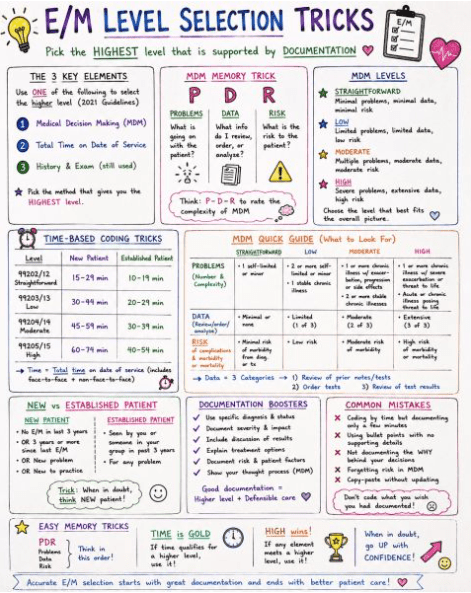
Selecting the correct Evaluation and Management (E/M) code is one of the most important responsibilities in medical coding and medical billing. A common misconception is that higher-level E/M codes lead to better reimbursement. In reality, the goal is not to choose the highest level—it is to choose the right level based on the provider's documentation.
Accurate E/M coding helps healthcare providers remain compliant, reduces the risk of claim denials and audits, and ensures they are appropriately reimbursed for the services they provide.
Whether you are a physician, medical coder, biller, or practice manager, understanding the basics of E/M coding can improve documentation quality and strengthen your Revenue Cycle Management (RCM) process.
What Is Evaluation and Management (E/M) Coding?
Evaluation and Management (E/M) coding is used to report patient visits in which a healthcare provider evaluates a patient's condition and makes decisions regarding diagnosis, treatment, and follow-up care.
These codes are commonly used for office visits, outpatient services, hospital care, nursing facility visits, and other healthcare encounters.
The selected E/M code should always reflect what actually occurred during the patient encounter and what is documented in the medical record.
How Are Office E/M Levels Selected?
Under the 2021 and later E/M coding guidelines for office and outpatient visits, the level of service is selected using one of the following methods:
- Medical Decision Making (MDM)
- Total Time spent by the provider on the date of the encounter
The provider does not need to use both methods. If either method supports a particular level of service and the documentation meets the requirements, that level may be reported.
Understanding Medical Decision Making (MDM)
A simple way to remember Medical Decision Making is the "PDR" method.
P = Problems Addressed
This refers to the number and complexity of the patient's conditions that are evaluated and managed during the visit.
D = Data Reviewed and Analyzed
This includes reviewing laboratory results, imaging studies, medical records, outside physician notes, or ordering and interpreting diagnostic tests when appropriate.
R = Risk of Complications and/or Morbidity
The provider considers the potential risks associated with the patient's condition, treatment decisions, diagnostic testing, medications, or possible complications.
When these three elements are evaluated together, they determine the overall complexity of Medical Decision Making.
When Can Time Be Used Instead of MDM?
Time may be used to select the E/M level when the provider documents the total qualifying time spent on the date of the encounter.
Qualifying time may include activities such as:
- Reviewing medical records before the visit
- Examining and evaluating the patient
- Counseling the patient or family
- Ordering medications, laboratory tests, or imaging studies
- Documenting the encounter
- Coordinating patient care
If billing based on time, the total time must be clearly documented in the medical record.
Why Documentation Is So Important
Documentation is the foundation of accurate E/M coding.
No matter how complex the patient encounter may have been, the selected code must always be supported by the provider's documentation. If the documentation does not support the reported level of service, the claim may be denied or the provider may face an audit.
Good documentation should clearly explain:
- The patient's condition
- The provider's assessment
- Medical decision making
- Treatment plan
- Any data reviewed
- Total time, if billing based on time
The medical record should always tell the complete story of the patient encounter.
Understanding New vs. Established Patients
Correctly identifying the patient's status is another important part of E/M coding.
A New Patient is someone who has not received professional services from the physician, or another physician or qualified healthcare professional of the same specialty within the same group practice, during the previous three years.
An Established Patient is someone who has received those professional services within the last three years.
Selecting the correct patient type helps ensure the appropriate E/M code is reported.
Common E/M Coding Mistakes
Many coding errors can be avoided with proper education and documentation.
Some of the most common mistakes include:
- Choosing a code based on assumptions instead of documentation.
- Selecting a higher-level code without sufficient support.
- Ignoring the complexity of Medical Decision Making.
- Forgetting to document total time when billing by time.
- Misclassifying a patient as new or established.
- Copying previous documentation without updating the current encounter.
Avoiding these mistakes improves coding accuracy and reduces compliance risks.
Best Practices for Accurate E/M Coding
Healthcare providers and coding professionals can improve coding accuracy by following a few simple best practices:
- Always code based on the provider's documentation.
- Understand the Medical Decision Making requirements.
- Document total time when billing based on time.
- Verify whether the patient is new or established.
- Stay current with CPT coding guidelines and payer policies.
- Review documentation before claim submission.
These practices help improve coding quality while supporting a healthier Revenue Cycle Management process.
Final Thoughts
Evaluation and Management (E/M) coding is not about maximizing reimbursement by selecting the highest code. It is about accurately representing the care that was provided.
Remember the simple PDR rule:
- P – Problems Addressed
- D – Data Reviewed and Analyzed
- R – Risk of Complications and/or Morbidity
When combined with complete documentation and proper application of the current E/M guidelines, these three elements make code selection much easier.
Choosing the right E/M code protects healthcare providers, supports compliance, improves claim accuracy, and helps ensure fair reimbursement.
Frequently Asked Questions (FAQs)
1. What is E/M coding in medical billing?
Evaluation and Management (E/M) coding is used to report patient visits where a healthcare provider evaluates a patient's condition, makes medical decisions, and develops a treatment plan. These codes help determine reimbursement for professional medical services.
2. What does E/M stand for?
E/M stands for Evaluation and Management. It refers to the process of evaluating a patient's health concerns and managing their care during a medical encounter.
3. How is an E/M level selected?
For office and outpatient visits, the E/M level is selected based on either Medical Decision Making (MDM) or the total qualifying time spent by the provider on the date of the encounter, provided the documentation supports the selected method.
4. What is Medical Decision Making (MDM)?
Medical Decision Making (MDM) is the process used to determine the complexity of a patient encounter. It is based on three elements: the problems addressed, the data reviewed and analyzed, and the risk of complications or morbidity associated with patient management.
5. What is the PDR method in E/M coding?
The PDR method is an easy way to remember the three components of Medical Decision Making:
- P = Problems Addressed
- D = Data Reviewed and Analyzed
- R = Risk of Complications and/or Morbidity
These elements help determine the appropriate E/M level.
6. Can E/M codes be selected based only on time?
Yes. Under the current office and outpatient E/M guidelines, providers may choose the E/M level based on total qualifying time spent on the date of the encounter, as long as the time is properly documented in the medical record.
7. What is the difference between a new patient and an established patient?
A new patient has not received professional services from the physician, or another physician of the same specialty within the same group practice, during the past three years. An established patient has received those services within the previous three years.
8. Why is documentation important in E/M coding?
Documentation supports the selected E/M code. If the provider's documentation does not justify the reported level of service, the claim may be denied or questioned during an audit. Accurate documentation is essential for compliance and proper reimbursement.
9. What are the most common E/M coding mistakes?
Common mistakes include selecting codes without documentation support, ignoring Medical Decision Making complexity, failing to document total time when billing by time, choosing incorrect patient status, and overcoding or undercoding patient visits.
10. How can accurate E/M coding improve Revenue Cycle Management?
Accurate E/M coding reduces claim denials, improves coding compliance, minimizes audit risk, speeds up reimbursement, and helps healthcare practices receive appropriate payment for the services they provide.
