
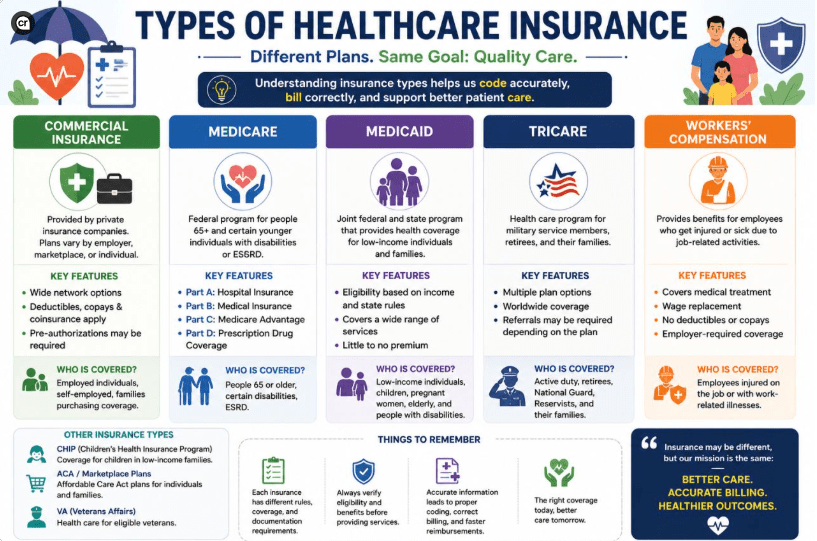
Understanding different types of health insurance is one of the first skills every medical biller and coder should master. Each insurance plan has its own rules for eligibility, coverage, claim submission, authorization requirements, and reimbursement. Knowing these differences helps healthcare providers submit accurate claims, reduce denials, and receive payments on time.
Whether you are new to medical billing or looking to strengthen your knowledge of Revenue Cycle Management (RCM), understanding insurance payers is essential for efficient claim processing.
Why Is It Important to Understand Different Insurance Types?
Every insurance company follows its own billing policies. A claim that is accepted by one payer may be rejected by another if the billing guidelines are not followed correctly.
When billing staff understand the requirements of each insurance type, they can:
- Verify patient eligibility correctly.
- Submit clean claims the first time.
- Reduce claim denials and rejections.
- Speed up reimbursement.
- Improve the patient's financial experience.
- Maintain compliance with payer guidelines.
In medical billing, identifying the correct payer is just as important as selecting the correct diagnosis and procedure codes.
Commercial Insurance
Commercial Insurance, also known as private health insurance, is provided by private insurance companies. Patients may receive this coverage through their employer or purchase an individual health plan directly from an insurance company.
Commercial insurance plans usually include different plan types such as PPOs, HMOs, EPOs, and POS plans. Each plan has its own network, referral requirements, copayments, deductibles, and coinsurance.
Before providing medical services, it is important to verify the patient's eligibility, benefits, and whether prior authorization is required.
Medicare
Medicare is a federal health insurance program primarily designed for individuals who are 65 years of age or older. It also provides coverage for certain younger individuals with qualifying disabilities or specific medical conditions.
Medicare is divided into different parts:
- Part A covers hospital services.
- Part B covers physician and outpatient services.
- Part C (Medicare Advantage) combines hospital and medical coverage through private insurance companies.
- Part D provides prescription drug coverage.
Medical billers must understand Medicare billing guidelines because documentation and coding requirements are often very specific.
Medicaid
Medicaid is a joint federal and state healthcare program that provides medical coverage to eligible low-income individuals and families.
Since each state administers its own Medicaid program, coverage rules, benefits, and reimbursement policies can vary significantly.
Medical billing professionals should always verify the patient's Medicaid eligibility and understand the billing requirements for the specific state Medicaid program.
TRICARE
TRICARE is the healthcare program for active-duty military personnel, National Guard and Reserve members, military retirees, and their eligible family members.
TRICARE offers several health plans depending on the beneficiary's military status and location.
When submitting claims to TRICARE, providers should verify eligibility, understand referral and authorization requirements, and follow TRICARE's billing guidelines to avoid unnecessary claim delays.
Workers' Compensation
Workers' Compensation provides medical benefits and wage replacement for employees who suffer work-related injuries or illnesses.
Unlike traditional health insurance, Workers' Compensation claims are generally billed to the employer's Workers' Compensation insurance carrier rather than the patient's personal health insurance.
Accurate documentation, injury details, employer information, and claim information are essential for successful Workers' Compensation billing.
Why Insurance Verification Matters
Regardless of the insurance type, insurance verification should always be completed before the patient's appointment.
During verification, healthcare providers confirm:
- Active insurance coverage
- Patient eligibility
- Covered services
- Copayment
- Deductible
- Coinsurance
- Prior authorization requirements
- Referral requirements
- Coordination of Benefits (COB), if applicable
Completing this step before treatment helps reduce claim denials and improves reimbursement timelines.
Common Challenges in Medical Billing
Medical billers frequently encounter challenges such as:
- Incorrect insurance information
- Expired coverage
- Missing prior authorizations
- Incorrect payer selection
- Coordination of Benefits (COB) issues
- Non-covered services
- Claim denials due to payer-specific rules
Understanding each insurance type helps billing professionals resolve these issues more efficiently.
Best Practices for Billing Different Insurance Plans
Healthcare organizations can improve claim accuracy by following these best practices:
- Verify insurance before every patient visit.
- Review payer-specific billing guidelines.
- Confirm eligibility and benefits.
- Obtain prior authorizations when required.
- Submit complete and accurate claims.
- Keep patient insurance information updated.
- Monitor claim status regularly.
- Respond quickly to claim rejections or denials.
These simple practices help improve the overall Revenue Cycle Management process and reduce unnecessary billing delays.
Final Thoughts
Every health insurance plan operates differently, but the goal remains the same: helping patients receive the healthcare they need while ensuring providers are reimbursed appropriately.
For medical billers and coders, understanding Commercial Insurance, Medicare, Medicaid, TRICARE, and Workers' Compensation is a fundamental part of the job. The more familiar you are with each payer's requirements, the more accurate your claims will be and the fewer denials your practice will experience.
Strong knowledge of insurance types is one of the foundations of successful Medical Billing and Revenue Cycle Management.
Frequently Asked Questions (FAQs)
1. What are the main types of health insurance in medical billing?
The five most common types are Commercial Insurance, Medicare, Medicaid, TRICARE, and Workers' Compensation. Each has its own eligibility requirements, coverage rules, and billing guidelines.
2. What is Commercial Insurance?
Commercial Insurance is private health insurance purchased by individuals or provided through an employer. It is offered by private insurance companies and may include HMO, PPO, POS, or EPO plans.
3. What is the difference between Medicare and Medicaid?
Medicare is a federal health insurance program primarily for individuals aged 65 and older and certain younger people with disabilities. Medicaid is a joint federal and state program that provides healthcare coverage for eligible low-income individuals and families.
4. What is TRICARE?
TRICARE is a healthcare program that provides medical coverage to active-duty service members, military retirees, National Guard and Reserve members, and their eligible family members.
5. What is Workers' Compensation insurance?
Workers' Compensation provides medical treatment and wage replacement benefits for employees who are injured or become ill because of their job. Claims are billed to the employer's Workers' Compensation insurance carrier.
6. Why is it important to identify the correct insurance payer?
Identifying the correct payer ensures that claims are submitted to the appropriate insurance company, reducing claim denials, payment delays, and unnecessary administrative work.
7. Why is insurance verification necessary before treatment?
Insurance verification confirms that the patient's coverage is active, identifies covered services, determines patient financial responsibility, and helps prevent billing errors before claims are submitted.
8. Can different insurance companies have different billing rules?
Yes. Every insurance payer has its own claim submission requirements, documentation standards, prior authorization policies, and reimbursement guidelines. Billing professionals must follow the specific rules for each payer.
9. What happens if the wrong insurance is billed?
Billing the wrong insurance company may result in claim rejection, payment delays, denied claims, and additional administrative work to correct and resubmit the claim.
10. How does understanding insurance types improve Revenue Cycle Management?
Understanding different insurance types helps healthcare providers verify eligibility accurately, submit clean claims, reduce denials, improve reimbursement timelines, and maintain a more efficient Revenue Cycle Management process.
Contact PayDoc Medical Solutions
Navigating different health insurance plans and payer requirements can be challenging, especially when every insurance company has its own billing rules and reimbursement policies. At PayDoc Medical Solutions, we help healthcare providers simplify the entire Revenue Cycle Management (RCM) process with accurate, compliant, and efficient medical billing services.
Our team specializes in:
- Insurance Eligibility Verification
- Prior Authorization
- Medical Coding (ICD-10, CPT & HCPCS)
- Medical Billing & Claim Submission
- Payment Posting
- Denial Management & Appeals
- Accounts Receivable (AR) Management
- Provider Credentialing & Enrollment
- Revenue Cycle Management (RCM) Solutions
Whether you are starting a new practice, looking to reduce claim denials, or want to improve your revenue cycle, our experienced professionals are here to help.
Contact us today to learn how PayDoc Medical Solutions can help your practice improve billing accuracy, maximize reimbursements, and streamline your Revenue Cycle Management process.
